


The Odyssey (2026) Review
Updated: Jul 18

To call Homer's ‘Odyssey’ merely one of the greatest works of literature is to understate its significance. First composed in the 8th or 7th century BC, the epic has captivated audiences for nearly three millennia, inspiring countless retellings and shaping the course of Western storytelling. The study devoted to the ‘Odyssey’ and its companion epic, the ‘Iliad’, at the Library of Alexandria helped lay the foundations of textual criticism and classical scholarship. Few works of art have exercised such a profound influence on literature, theatre and cinema, and fewer still continue to inspire audiences with such lasting power.
The poem follows Odysseus, the king of Ithaca, as he struggles to return home after the Trojan War. His decade-long voyage pits him against monsters, gods and temptations, while back in Ithaca his wife, Penelope, fends off increasingly aggressive suitors convinced her husband is dead and anxious to take his place. Blending adventure, mythology and themes of perseverance, identity and homecoming, the ‘Odyssey’ remains one of literature's defining works.

Christopher Nolan is the latest to adapt Homer's epic for the screen, following Uberto Pasolini's recent ‘The Return’, which focused solely on the latter half of the narrative. Nolan instead tackles the ‘Odyssey’ in its entirety, condensing its sprawling 24 books into a three-hour film. Given the poem’s legacy, any adaptation faces a formidable challenge: remaining faithful to one of history's most celebrated stories while finding something fresh to say.
Nolan is more than equal to the task. While inevitably truncated, his adaptation captures the scale, excitement and emotional sweep of Homer's epic. Although the first half-hour is burdened by exposition- as Nolan races to establish the world, its characters and the stakes of Odysseus' journey- once the voyage is underway, ‘The Odyssey’ becomes a tour de force- three hours of spectacle, drama and exhilaration that rarely loses its grip.

Nolan understands that the Odyssey endures not because of its monsters, but because of what they reveal about Odysseus himself. Each episode is given its own distinct flavour. The encounter with the Cyclops is staged as nerve-shredding horror, transforming Polyphemus' cave into a claustrophobic death trap, while Circe's island is steeped in a cold, eerie enchantment. The fall of Troy, glimpsed in flashback, is appropriately grand in scale, but Nolan is more interested in the aftermath than its spectacle.
Indeed, one of the film's most compelling ideas is its portrayal of Odysseus as a man haunted by war. Rather than treating Troy as a glorious victory, Nolan presents it as a psychological burden, with memories of the city's destruction- and the atrocities committed there- weighing heavily on his protagonist. It gives the familiar homecoming story an unexpectedly modern emotional core.
Crucially, Nolan also recognises that the Odyssey is not merely the story of a man trying to return home, but of those forced to survive through his absence. Penelope and Telemachus' struggle to preserve Ithaca provides a quieter counterpoint to Odysseus' voyage, exploring loyalty, family and the passage of time.
Having said that, not every creative decision lands. Some of the dialogue is surprisingly stilted, particularly in the film's quieter moments, and Nolan's repeated emphasis on Zeus' protection of strangers occasionally feels heavy-handed. While this is rooted in the Greek concept of xenia- the sacred duty of hospitality- the idea is explained so frequently it begins to resemble a narrative device rather than an organic part of the story.

Inevitably, some of Homer's episodic structure is lost in the transition to the screen. Certain encounters feel fleeting, and some characters appear more as symbols than fully developed figures. Yet Nolan's decision to prioritise Odysseus' emotional journey over strict completeness proves to be the correct one.
The film remains consistently engaging, thanks in large part to the extraordinary craftsmanship behind the camera. Shot on a remarkable scale with stunningly tactile realism, ‘The Odyssey’ is a feast for the senses. Every frame feels painstakingly realised, from the weather-beaten ships and battle-scarred ruins of Troy to the imposing halls of Ithaca. The production design avoids the polished artificiality that has characterised many recent historical epics, instead creating a world that feels authentic, dangerous and genuinely ancient.

Nolan and director of photography Hoyte van Hoytema understand when to embrace scale and when to favour intimacy. Sweeping vistas of the Mediterranean and towering city walls convey the mythic grandeur of Homer's world, while tighter, more claustrophobic framing heightens the tension of encounters such as the Cyclops' cave. Most impressive of all is Nolan's treatment of the sea itself. Rather than merely serving as a backdrop, it becomes an adversary in its own right- beautiful, unpredictable and terrifying- reflecting both Odysseus' physical journey and his psychological isolation.
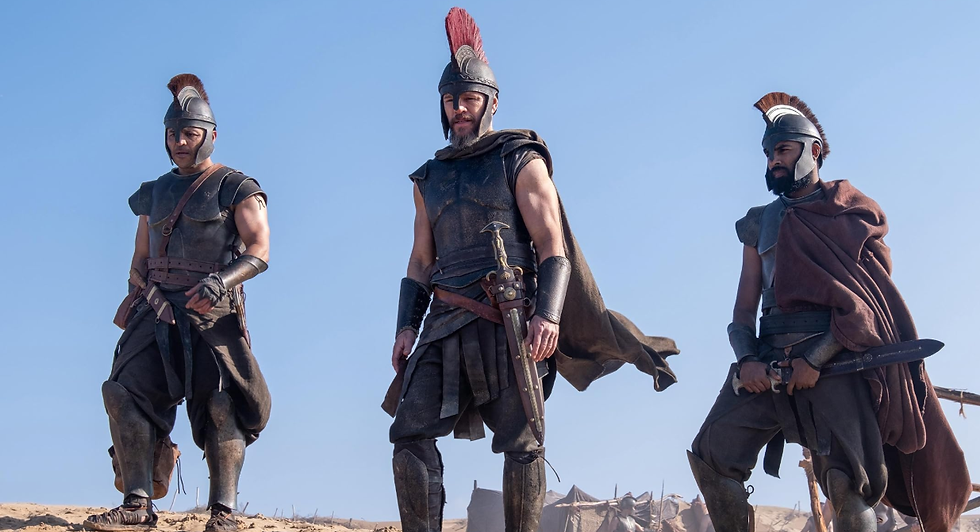
Equally impressive is the attention to detail throughout the film's world-building. Every location possesses its own distinct identity, from the austere grandeur of Ithaca to the unnerving tranquillity of Calypso's island. The costumes- though perhaps not entirely period accurate- likewise avoid the glossy excess often associated with historical blockbusters. Armour is dented and weathered, and clothing feels practical rather than theatrical, reinforcing the sense of a world shaped by hardship rather than fantasy.

Action scenes are hard-hitting, while the visual effects are employed with admirable restraint. Rather than overwhelming the audience with spectacle for its own sake, they enhance the mythology without sacrificing realism. The Cyclops, the storms and the supernatural encounters all feel tangible, seamlessly integrated into the physical environments around them. Particularly striking is Nolan's treatment of Circe's magic, recalling the unsettling body horror of David Cronenberg rather than traditional fantasy spectacle. The sequence is both mesmerising and deeply unnerving, demonstrating Nolan's ability to make even the most fantastical elements of Homer's world feel grounded.
Complementing the visuals is an outstanding soundscape. From the groaning timbers of Odysseus' ship to the crashing surf and thunderous battle sequences, the sound design creates a constant sense of immersion, while Ludwig Göransson’s score lends the film both grandeur and melancholy without becoming overbearing. Jennifer Lame's astute editing also deserves mention, maintaining a remarkable sense of momentum throughout. Despite its near three-hour runtime, ‘The Odyssey’ rarely feels overextended or overindulgent.

The film's success is also driven by a powerful ensemble, led by Matt Damon’s Odysseus. Damon brings a compelling combination of weariness and determination to the role, capturing both the character's legendary cunning and the psychological scars left by years of war and wandering. John Leguizamo is equally impressive as the ever-loyal swineherd Eumaeus, bringing warmth and humanity to one of the epic's most steadfast figures.
Robert Pattinson relishes his role as the snake-like suitor Antinous, delivering a performance reminiscent of Joaquin Phoenix's Commodus in ‘Gladiator’- a villain whose arrogance and cruelty make him deeply satisfying to despise. Anne Hathaway does similarly strong work as Penelope, portraying her not merely as a woman waiting for her husband's return, but as someone defined by intelligence, resilience and quiet strength.

Elsewhere, Charlize Theron and Samantha Morton make strong impressions as Calypso and Circe respectively, both deserving of more substantial screen time. Mia Goth, Zendaya and Jon Bernthal's roles, meanwhile, feel somewhat underdeveloped, leaving three talented performers with little opportunity to make a lasting impact. The one notable disappointment is Tom Holland's unconvincing Telemachus, a performance that struggles to capture the emotional complexity and depth required of the character.
Ultimately, Christopher Nolan has achieved what few filmmakers would dare attempt: translating one of humanity's oldest stories into a cinematic language without losing sight of its soul. ‘The Odyssey’ may sacrifice some of Homer's sprawling detail, but in focusing on the trauma, resilience and longing at the heart of Odysseus' journey, Nolan captures the reason the epic has endured for nearly three thousand years. Grand in scale, intimate in emotion and crafted with extraordinary skill, this is an effective, entertaining new chapter in the storied history of Homer's masterpiece. It may take the long way home, but ‘The Odyssey’ really is a worthwhile cinematic trip.


