


The Last Viking (2025) Review
Updated: Jun 22

Anders Thomas Jensen is a singular voice in cinema. Managing to balance cynicism with compassion in a way few filmmakers can, his films concern themselves with misfits, eccentrics and society's castaways- lonely souls colliding in stories that are at once absurdly funny and unexpectedly moving. In a 2007 essay on Danish cinema, film historian David Bordwell stated “as there was the Lubitsch touch and the Wilder touch, we can now speak of the Jensen touch- a twinge of pathos acknowledged quietly, relying on our sympathy for the characters' bizarre frailties." Few descriptions better capture the peculiar alchemy of Jensen's work; once again at play throughout ‘The Last Viking’.
A strangely touching black comedy, it centres on recently released criminal Anker, who, fifteen years earlier, entrusted his brother Manfred with the loot from a robbery. In the intervening years, Manfred developed dissociative identity disorder (DID), now answering only to one name: John. John Lennon. Their search for the missing fortune takes the brothers back to their childhood home, where a gallery of oddballs and unresolved traumas await them.

It’s fantastic, brimming with Jensen’s trademark wit. His narrative is engaging and deceptively simple, the dialogue offbeat and, often, hilarious. Jensen’s characterisation is equally strong- from Manfred, with his delusion that he is John Lennon, to Margrethe and Werner, the bickering couple now living in the old family home, and Lothar, a psychiatrist whose own madness may or may not contain a method. All interact believably, creating a warmly felt world of eccentricity in which nothing feels banal.
Jensen strikes for comedic gold in many directions, consistently hitting the mark- a subplot involving Lothar and Manfred assembling a group of DID patients who believe they are The Beatles (as well as ABBA) is particularly endearing and amusing. Yet the film is not merely entertaining; it is also unexpectedly poignant. The relationship between Anker and Manfred is rendered with sadness, feeling most authentic. The trauma of their shared history carries real weight, lending the film a serious undercurrent. In addition, moments of violence throughout land with brutal force, standing in sharp contrast to the film’s often light tone.

While the film uses dissociative identity disorder in a heightened, stylised manner, Jensen never treats Manfred’s condition as a cheap punchline. The portrayal is far from clinical realism, but it captures an emotional truth about fractured identity and unresolved trauma- an example of what Werner Herzog terms “ecstatic truth,” where emotional or poetic insight outweighs literal accuracy. It aligns perfectly with the film’s broader interest in damaged psyches.
In short, beneath the narrative’s comedy lies a thoughtful portrait of mental illness, of how nature and nurture can sometimes violently distort a person’s sense of self; like firm hands on wet clay. More broadly, it is also a study of brotherhood, and of broken, makeshift families- connection formed between misfits and outcasts who, despite everything, find a fragile kind of belonging with one another.
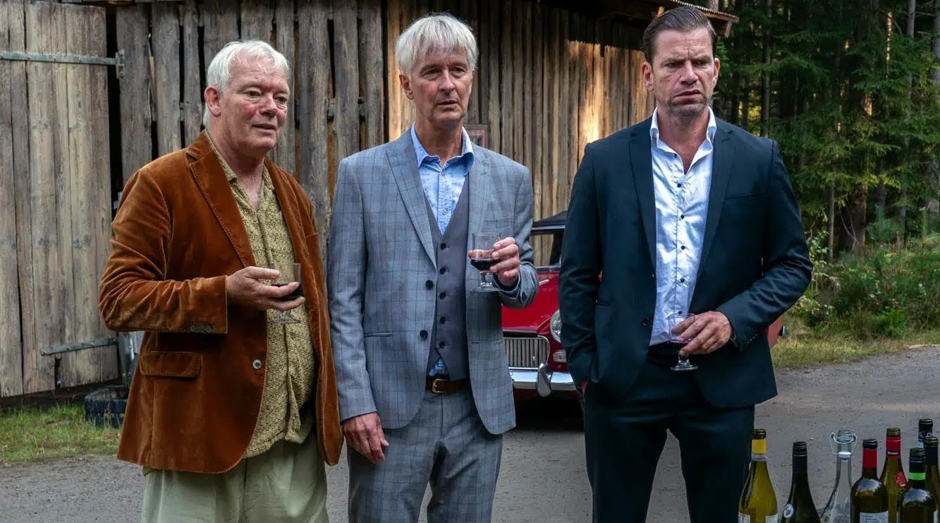
In other words, there is a lot going for it narratively- as well as technically. Jensen’s frequent collaborator Sebastian Blenkov’s cinematography is strikingly naturalistic, yet not without stylizations. His use of colour in particular gives natural scenes a beauty that feels almost otherworldly. Costume designer Rikke Simonsen’s outfits contribute subtly to characters’ personalities, while Anders Albjerg Kristiansen and Nicolaj Monberg’s astute editing keeps proceedings running along at a smooth pace.
One of the finest actors of his generation, Mads Mikkelsen delivers a masterclass as Manfred, balancing fragility, confusion and deadpan humour with extraordinary control. Few actors can convey such depth of emotion with nothing more than a glance; Mikkelsen does so with remarkable precision and restraint. As the more stoic yet volatile Anker, Nikolaj Lie Kaas is equally compelling, grounding the film while quietly allowing frustration and anger to simmer beneath the surface, providing a sharp counterpoint to Mikkelsen’s eccentric unpredictability.

Sofie Gråbøl is a constant delight as the vain Margrethe, her chemistry with Søren Malling’s Werner leading to some great moments of spousal banter. As Lothar, Lars Brygmann is nothing short of a triumph- one is never certain where he stands on the spectrum of sanity, while Kardo Razzazi’s DID patient Hamdan is a real scene-stealer. Nicolas Bro and Lars Ranthe also contribute effectively to the piece, as a chilling thug and Manfred and Anker’s father, respectively.
In the end, Anders Thomas Jensen’s ‘The Last Viking’ distils everything that makes him such a singular filmmaker. It is a world of misfits and broken men, where humour and violence coexist uneasily, where connection is always provisional. Yet within its absurdity lies something unexpectedly tender: a belief that even the most fractured individuals can form fragile, yet profound bonds. Strongly acted, confidently directed and visually striking; ‘The Last Viking’ deserves a place in cinematic Valhalla.


