


Cobweb (2023) Review
Updated: Jun 5

Kim Jee-woon is a cinematic shapeshifter. From the explosive kimchi western 'The Good, The Bad, The Weird,' to comedies like 'The Quiet Family' and 'The Foul King,' as well as the violent, hyper-stylish 'A Bittersweet Life' and 'I Saw the Devil,' he has refused to be pigeon-holed and consistently entertained. A genre-hopping madman, Kim approaches each project with a restless creativity, making his work impossible to predict and endlessly rewarding to watch.
His 2023 feature 'Cobweb' centres on Director Kim-yeol, a filmmaker in early 1970s Seoul, who is consumed by the belief that his latest project could be his masterpiece. Having already got the film in the can, he’s convinced that the ending needs to be reshot in order to salvage what he sees as a compromised vision. What follows is a frantic attempt to complete the film inside a single studio set, with production is thrown into disarray by censorship officials, actors' personal dramas and long buried secrets.

Written by Kim and Shin Yeon-shick, it is fabulous, playing like a classic screwball comedy, with sharp, rapid-fire dialogue and a cast of delightfully heightened characters. From Director Kim, driven by his dreams to the point of madness, to the perpetually typecast extra who plays policemen so often that he has a jail cell built in his home to help him prepare for roles, and Mi-do, the studio chairwoman's niece, whose tough exterior masks a genuine love of performance; 'Cobweb' is packed with memorable personalities. All are eccentric, larger-than-life figures, yet Kim imbues them with enough humanity as to remain relatable.
In many ways, it is quite like Kōki Mitani’s 'Welcome Back, Mr. McDonald,' both concerned with the chaos of creation, set largely in one location and unfolding in something approaching real time. However, if the two films are related, Kim's is the more anarchic sibling, at times verging into tonal overload and narrative congestion. It could be argued that a few sub-plots could be trimmed without overly affecting the narrative, while improving the overall flow.

Having said that, it remains enjoyable, particularly in its depiction of the melodramatic film-within-a-film that Director Kim is convinced is his masterpiece. Shot in black-and-white and packed with increasingly outlandish twists, reversals and betrayals, it becomes a heightened, almost absurd distillation of his creative ambitions- both a parody of cinematic excess and a reflection of the central character's increasingly unravelling vision. Further, the meddling of the fervent anti-Communist censor leads to many humorous moments; whilst also functioning as a critique of bureaucratic intrusion into the arts.
Visually, 'Cobweb' matches its narrative mania with a restless, yet feverish controlled approach. Cinematographer Kim Ji-yong's camera rarely sits still, drifting through the studio space as though it cannot decide where to look, echoing the production's collapsing sense of order. The film-within-the-film's stark black-and-white, high-contrast aesthetic immediately sharpens this tension, heightening the divide between cinematic artifice and the increasingly unruly reality of the shoot unfolding around it. The result is deliberately claustrophobic, orchestrated chaos- the single set a constantly shifting arena of performance and panic.
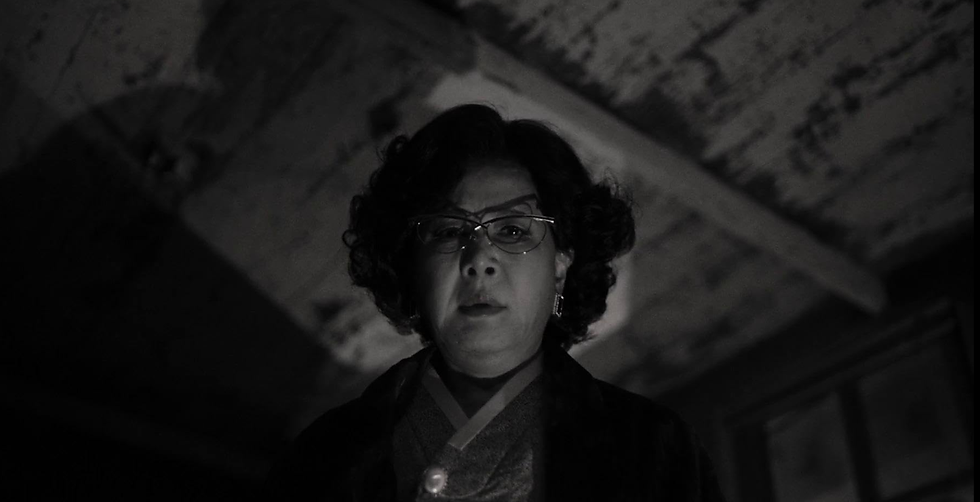
The meticulous production design plays a crucial role in sustaining this illusion. The studio set is richly detailed, layered with the textures of classic filmmaking, from period equipment to carefully recreated backlot spaces that feel both authentic and slightly unstable, as if they might collapse under the weight of the production. Even the film-within-the-film's visual language reinforces this instability, its monochrome stylisation intensifying the sense that we are watching two realities slowly bleed into one another.
Proceedings' frenetic energy is underpinned by Jinmo Yang’s seamless editing style. His cuts ensure the film never loses a sense of rhythm or pacing. This is most evident in the extended oner sequence, which moves between the "real" production and the film-within-the-film in a continuous flow of choreography, camera movement and performance, sustaining coherence even as the action spirals.

The sound design is equally dense, layering studio noise, off-screen commotion and overlapping dialogue into a constantly active sonic space, mirroring the film's thematic fixation on artistic overload. Mowg's original score oscillates between melodramatic grandeur and playful irony, simultaneously amplifying emotion and exposing the artificiality beneath it, while period songs are used to great effect throughout.
Song Kang-ho stars as Director Kim, marking his fifth collaboration with Kim Jee-woon. Apparently inspired by Kim Ki-young, Song delivers a typically superb performance, managing to be mad without ever tipping into mania, obsessive without becoming unhinged. It is a classic Song turn: energetic, deeply human and always grounded in emotional truth, even at its most heightened.
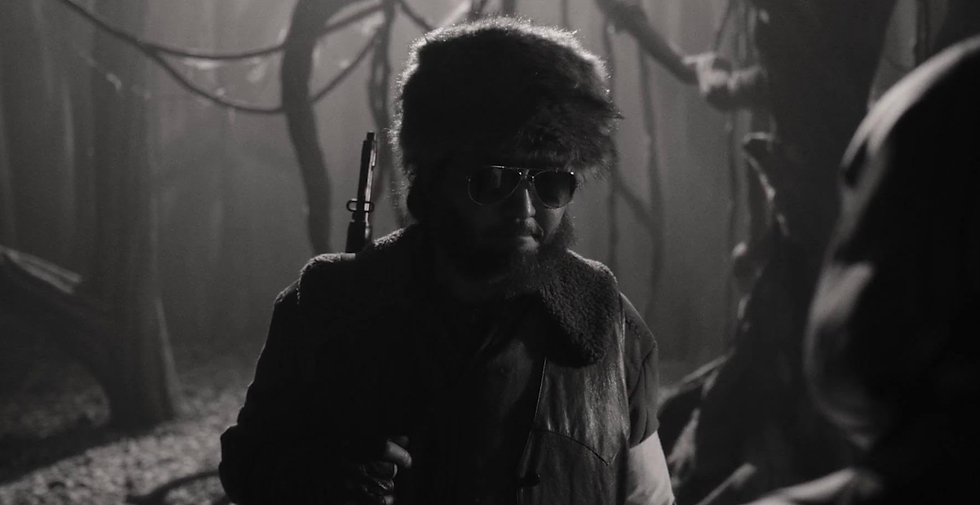
His supporting cast are all equally commendable. Jeon Yeo-been, as Mi-do, and Krystal Jung, as Yu-rim, the up-and-coming actress in the film-within-the-film, deserve particular mention, both tapping into the material's anarchic vein. Jeon is tough, effective and consistently likeable, while Krystal embraces the character's scheming tendencies with real relish. Further, Jung Woo-sung has a small, but memorable role as Director Kim's mentor, another eccentric presence, proving no less unhinged than those he advises; despite his initially calm exterior.
Ultimately, Kim Jee-woon's 'Cobweb' is a riotous celebration of creative obsession. While its energy can occasionally tip into excess, Kim's grasp over tone, rhythm and performance ensures it rarely falters. It is a film about chaos that is, paradoxically, meticulously constructed- and that tension between control and collapse is what makes it so consistently engaging. Boasting fine performances and an assured visual style, 'Cobweb' is worth getting tangled up in.


