


Citizen Vigilante (2026) Review
Updated: Jul 21

Uwe Boll is a one-of-a-kind filmmaker: the rat-king of cinema. With over 30 feature films spanning decades, Boll has built one of the most singular filmographies in modern times- one defined not only by critical disdain, but by sheer persistence. His career is a collision of controversy, exploitation and defiance, a body of work that seems almost designed to provoke. A paragon of bad taste, Boll shows no indication of stopping anytime soon.
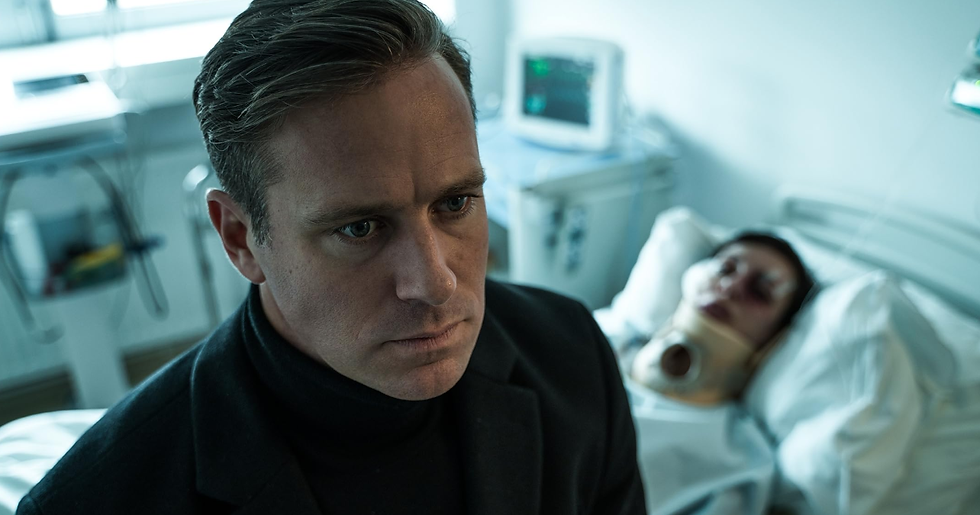
The 2026 feature ‘Citizen Vigilante’ has proven to be among Boll’s most inflammatory. It follows an American living in an unnamed European country, whose frustration with the failures of the justice system leads him to take the law into his own hands. A self-appointed vigilante, he metes out his own brand of justice- as judge, jury and executioner.

Although comparisons to ‘Death Wish’ are unavoidable, ‘Citizen Vigilante’ isn't so much a cheap knock-off as an echo of that franchise's dying days. Like the later Bronson sequels, it mistakes relentless violence for dramatic weight, resulting in a joyless procession of bloodshed and overtly right-wing political messaging that quickly becomes monotonous.
If the film's politics are blunt, its screenplay is positively concussed. The dialogue is among the worst put to screen in years, with characters speaking in clumsily expositional, slogan-like declarations rather than anything resembling natural conversation. The plot fares little better, amounting to a succession of assaults tenuously connected by the Vigilante's mission. Instead of building tension, the film simply piles misery upon misery until it becomes numbing.
Political films do not have to be nuanced; for example, Paul Thomas Anderson’s recent ‘One Battle After Another’ is about as subtle as a kick in the teeth with a pair of hobnail boots. However, the problem with Boll’s effort is not that it is heavy-handed- which it is- but that its ideas are so painfully basic. Mistaking provocation for insight, Boll presents complex social issues in the broadest possible strokes, confusing repetition with argument. However strongly one agrees or disagrees with its politics, there is remarkably little beneath the surface to engage with.
It is also a tonally confused film. For all its seriousness, it contains bizarre flashes of comedy throughout, notably a scene involving the Vigilante, a prostitute and a mould problem. These moments might suggest a satirical intent, but the film rarely seems aware of the contradictions it creates. Most bafflingly, the Vigilante, who is partly waging a war against illegal immigration, is himself an illegal immigrant. Whether this is deliberate irony or simply a failure of consistency is difficult to determine. Either way, one is left wondering: what exactly was Boll thinking?

The strangest thing about ‘Citizen Vigilante’ is that much of the debate surrounding it has become more extreme than the film itself. Critics on the left have accused it of being racist and Islamophobic, while some on the right have presented it as a brave and uncompromising piece of political filmmaking. Neither interpretation is entirely accurate. The film does engage with genuine social concerns, but it handles them with all the subtlety and complexity of a tabloid headline.
That shallow heavy-handedness extends to the film’s treatment of social media itself. At times, it suggests that online outrage and viral attention have helped fuel the Vigilante’s actions, presenting a world where public anger can become a substitute for justice. Yet Boll never fully commits to whether this is meant as criticism, observation or endorsement. Once again, the problem is not that the film addresses these subjects, but that it lacks the nuance required to examine them.

The issues it touches upon are not imaginary. Some migrants commit violent crimes, just as members of any large population do, and acknowledging specific cases should not be controversial. However, the existence of a problem does not excuse simplistic or sensationalised treatment of it. These incidents are frequently seized upon by certain media commentators as evidence that an entire group of people is dangerous. Boll's screenplay risks reinforcing that same kind of reduction by presenting a complicated subject through a series of crude, violent scenarios.
It is worth noting that some of the more extreme criticism does not quite match what is actually on screen. It is inaccurate to claim that every cruel, inhumane act in ‘Citizen Vigilante’ is committed by migrants, or that the Vigilante exclusively targets people of colour. The film's problems are not that simple. Its failure lies less in what it depicts than in the way it depicts it: reducing complicated social tensions into a simplistic cycle of brutality and revenge. The result is a film that raises difficult questions but has little interest in providing anything resembling thoughtful answers.

In short, more thought appears to have gone into analysing the film than Boll put into writing it. The technical shortcomings are even more glaring, as ‘Citizen Vigilante’ may well be one of the worst-edited films of the past few decades, making the average Steven Seagal direct-to-video action film look like the work of Thelma Schoonmaker.
As an example, editor Ethan Maniquis seems to believe that twenty-seven cuts during a scene of someone walking up a flight of stairs creates urgency. It doesn't. It simply draws attention to the editing itself, turning what should be a routine moment into a frantic jumble, exposing just how little tension the scene is capable of generating. The whole film is edited that way; it is exhausting incompetence.

On the other hand, Boll’s moody, gloomy cinematography remains in focus for most, if not all, of the runtime. If you were feeling particularly generous, you could say the film has a certain gritty, Eastern-European atmosphere, which the bleak production design compounds. Further, to its credit, the over-the-top action scenes are surprisingly well realised, though Rodolfo Matulich’s ear-grating score sounds like it was composed specifically to prepare the viewer for torture.
Aside from Elon Musk’s promotion of it on X, the other major curiosity surrounding the film is the return of Armie Hammer, once a Hollywood star before his personal life overshadowed his work. As the Vigilante, Hammer seems about as pleased as a man who went from headlining a Kenneth Branagh film to starring in a Boll production could possibly be. He gives a stoic, one-note performance, while Costas Mandylor does steady, if unremarkable, work as the inspector pursuing him. The rest of the cast appear to have been dragged in off the street and forced to act under duress.

Ultimately, Uwe Boll’s poorly written, abysmally edited ‘Citizen Vigilante’ is not notable for its politics; rather because a clumsy, simplistic exploitation film has been inflated into something far more significant by the culture war surrounding it. That it required the intervention of one of the world's most influential people to become a talking point says more about the current media landscape than it does about the film itself. In the end, ‘Citizen Vigilante’ spends an hour and a half demanding justice. The audience may find themselves demanding the same thing.


