


The Hit (1984) Review
Updated: Aug 20

In 1971, Stephen Frears made his directorial debut with 'Gumshoe', a well-received noir comedy that nevertheless failed to launch his feature film career. Frears spent the next decade honing his craft in television, directing episodes of 'Play for Today' and 'BBC2 Playhouse', along with several television films, including 1975's 'Three Men in a Boat'. He wouldn't return to cinemas until 1984’s 'The Hit'.
It follows ex-gangster Willie Parker, who has spent the past decade living in sun-bleached Spain after informing on his former associates. However, the mob never forgive, nor forget, and the past finally catches up with him. Parker is abducted by stoic hitman Braddock and his young associate, Myron, and taken on a cross-country journey to France, where he is to be executed. On the way, they pick up a Spanish woman named Maggie, turning an already perilous journey into something more complicated.

An interesting, odd movie, ‘The Hit’ lingers in the mind long after the credits have rolled. With a screenplay by Peter Prince, it’s not a straightforward gangster picture by any means. While there are moments of quite messy and realistic violence, they are few and far between. The dialogue is sharp and philosophical, revealing plenty about the characters without feeling the need to spell everything out. Frears is equally comfortable letting scenes play out in silence, allowing glances and pauses speak volumes.
This gives proceedings a leisurely, almost languid quality, as the four travel through the beautiful Spanish landscape. Yet there is always an underlying tension, as we know exactly what fate is awaiting Parker. The journey itself is the film’s narrative engine, with the evolving dynamics between its characters proving more important than the relatively simple crime story surrounding them. There is also a wonderfully dry sense of humour running throughout.
Some might find the pacing problematic (Vincent Canby certainly did, dubbing the film a “disappointing… witless chase”) and the central conceit- that the mob want Parker to be transported to Paris instead of simply whacked- doesn’t really make much sense. However, Frears is less interested in the mechanics of the hit than in what happens to people forced to confront their own mortality. The journey is an opportunity to examine regret, fate and the strange bonds that form between people who, under normal circumstances, would have no reason to spend any time together.
There is also an intriguing fascination with professionalism and the way people respond when faced with danger. Braddock operates according to a rigid code, respecting those who refuse to back down, even when they have every reason to be afraid. Parker's calm acceptance of his predicament earns his respect, while Maggie's willingness to fight for herself does likewise. By contrast, those who hesitate or lose their nerve are viewed with considerably less sympathy. It's a cold philosophy, but it gives an interesting perspective on courage, suggesting that bravery isn't necessarily about being fearless, but about how one conducts themselves when fear inevitably arrives.

It is also strikingly good-looking, Frears and director of photography Mike Molloy making excellent use of the Spanish landscape. The heat is palpable, with a shimmering haze rising from the roads and dusty expanses stretching into the distance. The film’s pace is reflected in its imagery, allowing the camera linger on the landscape and the people passing through it. Yet Frears and Molloy know exactly when to move the camera and when to leave it completely still. Their approach is intuitive, mirroring the characters themselves: relaxed and reflective one moment, suddenly alert and violent the next.
Frears and Molloy also make striking use of close-ups, giving the cast plenty of room to communicate without words. A great deal is conveyed through expressions and glances; Frears frequently puts the actors' faces front and centre. As Al Pacino famously put it in ‘Scarface’, “The eyes, Chico. They never lie.” An awful lot is said in ‘The Hit’ without anyone opening their mouth.

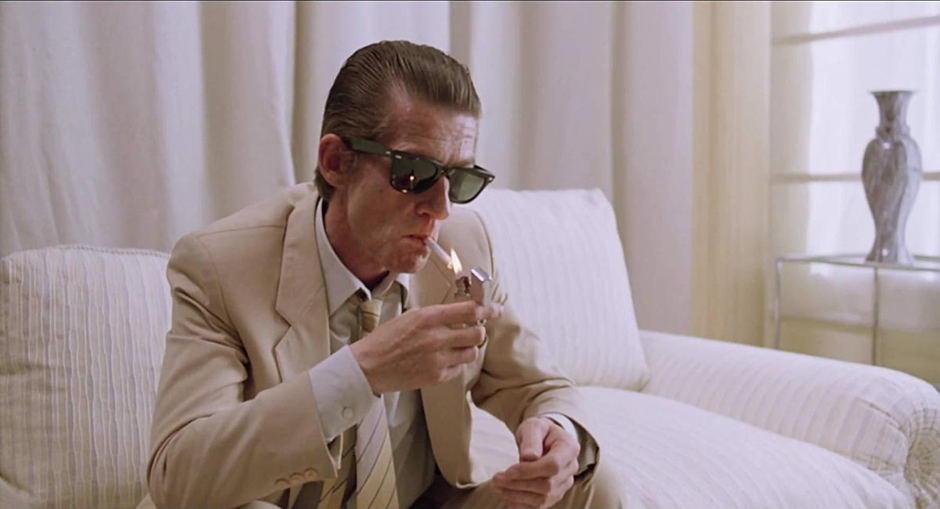
Marit Allen’s costume design is another memorable aspect, with the clothing helping define the characters; Parker in crisp whites, a messianic figure of composure, next to Myron’s chaotic leather and Braddock’s deliberately innocuous suit. Mick Audsley’s editing, meanwhile, maintains the film's unhurried rhythm without allowing it to become stagnant.
The score, composed by Paco de Lucía, is somewhat less subtle. At times it feels overbearing, particularly when the music pushes emotions that are already being effectively communicated. Elsewhere, however, it provides considerable emotional weight, while the title track, performed by Eric Clapton and Roger Waters, adds another layer to the film's melancholic atmosphere.

Performances are uniformly excellent. Terence Stamp brings something almost spiritual to Willie Parker. There is a strange Christ-like quality to him as he travels down the road to dusty death, apparently having accepted his fate while simultaneously planting seeds of doubt in the minds of his captors. Yet Parker is hardly a saint; he is a selfish stool-pigeon who betrayed his former associates to save himself. Stamp embraces that contradiction beautifully, making Parker simultaneously resigned, manipulative and oddly philosophical.
In his first film role, Tim Roth is terrific as Myron, a bundle of energy whose youthful naivety masks a dangerous streak. Roth plays him as a young man desperate for Braddock's respect, eager to prove himself and prone to extreme acts of violence, yet increasingly caught between his duty to Braddock and his own conscience. There's something almost boyish about his need for approval, but Roth never loses sight of the danger beneath it, making Myron's uncertainty feel entirely believable.

The inimitable John Hurt’s Braddock is a cool, cruel thug capable of anything. Yet as the film progresses, cracks begin to appear in his armour, revealing a man who is less emotionally impervious than he initially seems. By the end, he nears a position not entirely unlike Myron's, torn between his professional obligations and something more human. It is a testament to Hurt's performance that we find ourselves almost sympathising with Braddock, despite his being a brutish killer.
Laura del Sol does strong work as Maggie, a feisty, independent woman who refuses to go gently into that good night. Her scenes alone with Hurt are among the film’s most intriguing, revealing unexpected sides to their characters. Bill Hunter is equally impressive in the smaller role of Harry, a compatriot of Braddock's. He completely steals his few scenes, his frightened, energetic performance providing a wonderful counterpoint to Hurt's coolness and Stamp's composure. Fernando Rey also appears as a policeman, but has frustratingly little to do, with only a single line; a waste of such a talented actor.

Ultimately, ‘The Hit’ is an offbeat film that turns a simple gangster premise into something much more reflective. Its leisurely pacing may frustrate some, and the plot may be somewhat contrived, but superb performances, striking photography and Frears’ sensitivity to character make the journey worthwhile. Exploring mortality, courage, regret and unexpected human connection, it is a strange, quietly affecting film that stays with you. In short, ‘The Hit’ is, for want of a better word, a hit.


