


The Executioner (1974) Review
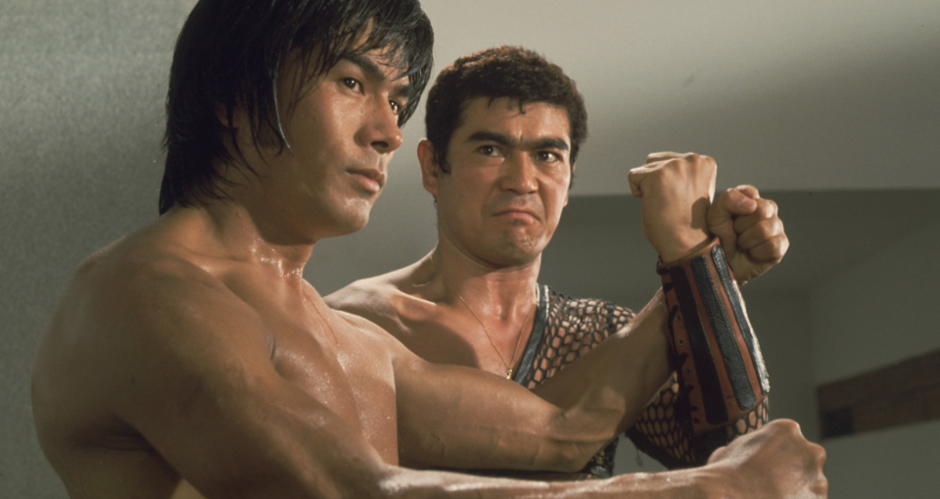
Sonny Chiba is a legend. The action superstar began acting in the early 60s, rapidly making a name for himself as a charismatic, martial arts madman. By the 1970s, he was one of Japan's biggest stars, spearheading a wave of brutally violent action flicks, influencing generations of filmmakers, including Takashi Miike and Quentin Tarantino. From ‘The Street Fighter’ to ‘The Killing Machine,’ ‘Kill Bill Vol. 1’ and ‘The Storm Riders,’ Chiba showcased his talents across martial arts films, fantasy epics, crime thrillers and even Hollywood blockbusters.
Alongside Kôsei Saitô’s ‘G.I. Samurai’, Teruo Ishii's ‘The Executioner’ stands as one of the wackiest entries in his varied filmography. On paper, its premise is straightforward: three men are hired by a former police commissioner to dismantle a drug-smuggling ring in Tokyo. What follows, however, is anything but conventional.

Tonally schizophrenic, it’s a weird, wild film, melodramatic and funny in equal measure. When Ishii lets the madness take over, ‘The Executioner’ is a blast- a bizarre fusion of martial arts, crime caper and comedy where anything feels possible. The film is packed with cartoonish villains, absurd situations and moments seemingly designed purely to make the audience wonder what they’re watching.
The problem is that it doesn’t always commit to that insanity. For every wonderfully bizarre set piece, there’s a slower, more melodramatic sequence threatening to bring the momentum to a halt. These dramatic moments aren’t necessarily bad, but they belong to a very different film- one that struggles to coexist with the gleefully ridiculous chaos surrounding it.

The characters themselves highlight this tonal struggle. The villains are a camp bunch, while the “lewd” member of the trio, who is always trying to “get some”, feels like a comic sidekick from a Jackie Chan farce. In the film’s more outrageous moments, his hilarious antics are perfectly in keeping with Ishii’s anarchic style. However, placed alongside the darker themes of drug trafficking and violence, he becomes another reminder that ‘The Executioner’ is constantly caught between two very different identities.
Despite these inconsistencies, the film is undeniably unique. Its tonal clashes are occasionally frustrating, but also part of what makes the film so memorable. Beyond its eccentric storytelling, ‘The Executioner’ is visually striking, boasting crisp cinematography from Yoshikazu Yamazawa. Despite being over fifty years old, the film remains remarkably sharp, now serving as a vibrant time capsule of early 70s Japan. Hiroshi Fujita’s sleek production design captures a rapidly changing urban landscape, while the visual compositions give the film a sense of sophistication, contrasting with its often-ridiculous plot.

Fumio Soda’s editing, meanwhile, matches the film’s restless energy. With a frantic pace and a willingness to bound between genres, Soda’s dynamic cutting style heightens the thrills, adding to the unpredictable nature of proceedings. Further, Hajime Kaburagi’s score is the complete personification of late 60s, early 70s soundtracks, full of funky basslines, groovy rhythms and jazzy flourishes. It may be a little overbearing at times- particularly with its use of the Jew’s harp- but it’s fun.
The film is never dull, thanks in large part to the well-choreographed action scenes. The fights are energetic and bombastic, filled with creative choreography showcasing Ishii’s flair for spectacle. Whether it’s a chaotic brawl in an alleyway involving coloured paint, or a tightly staged confrontation in a mafia compound, the action consistently delivers a sense of exciting physicality.

The film would not work nearly as well without its charismatic cast. Sonny Chiba brings his trademark intensity and effortless screen presence to the role of master ninja Ryuichi Koga, while Makoto Satô does strong work as Takeshi Hayato, the ex-cop and unofficial leader of the trio. Eiji Gō is a particular highlight as the group’s lecherous comic relief, a character who could have felt out of place but somehow doesn’t. Shozo Saijo also makes a strong impression as Blazer Nishiyama, a famed fighter hired to challenge the three men. The rest of the cast help maintain the film’s unpredictable momentum and heightened tone.
Overall, Teruo Ishii’s ‘The Executioner’ is not a great movie, but it is an entertaining one, serving as a terrific showcase for Sonny Chiba’s talents. Its tonal inconsistencies occasionally hold it back, with its darker crime elements struggling to coexist alongside its outrageous comedy. Yet, those contradictions are also what make the film so memorable. Visually striking, relentlessly energetic and anchored by a committed cast, ‘The Executioner’ is a wonderfully strange piece of 1970s Japanese cinema- martial-arts mania.


