


That Man from Rio (1964) Review
Updated: Jul 24

Some of cinema's most unforgettable performers have been those willing to put themselves in harm's way. Buster Keaton transformed gravity into comedy through astonishing physical stunts, while Jean-Paul Belmondo was cut from the same cloth, performing daring feats with a grin suggesting he enjoyed every second of it. His charismatic screen presence would inspire stars such as Chow Yun-fat, while Jackie Chan would blend Keaton's gift for visual comedy with Belmondo's physical exuberance into a style entirely his own.
Few films capture Belmondo’s unique blend of danger and playfulness better than Philippe de Broca's ‘That Man from Rio’. The film follows Adrien Dufourquet, a young French soldier whose leave is interrupted when his fiancée Agnès is kidnapped. Pursuing her abductors from Paris to Rio de Janeiro, Adrien and Agnès become caught up in a globe-trotting escapade involving Amazonian artefacts, murder, mystery and intrigue.

Originally intended as a James Bond spoof and a follow-up to ‘Cartouche’, it is an absolute blast from beginning to end. De Broca keeps the story in near-constant motion, moving effortlessly from one chase, escape and comic misunderstanding to the next without ever sacrificing the film's infectious sense of fun. Engaging and exciting, it plays as if Peter Sellers' madcap energy had been fused with Harold Lloyd's fearlessness, resulting in an endlessly rewatchable epic.
From the Indiana Jones series to Stephen Sommers' ‘The Mummy’, and almost certainly some of the later Bonds, many of cinema's greatest adventures owe a debt to de Broca's film. Its country-hopping search for ancient idols, combined with romance, comedy and spectacular action, became a blueprint for countless romps that followed. While its story is hardly unpredictable, ‘That Man from Rio’ remains a hugely rewarding showcase for inventive stunt work, breathtaking locations and the sheer thrill of the chase.

Director of photography Edmond Séchan makes excellent use of the film's international locations, transforming Paris, Rio de Janeiro, the still-developing modernist city of Brasília, and the depths of the Amazon jungle into visceral, immersive, danger-filled landscapes. The futuristic architecture of Brasília provides an especially intriguing backdrop, its vast open spaces and unusual designs giving the film a sense of scale and modernity, contrasting beautifully with the mystery of the jungle.
Mauro Monteiro’s production design further enhances this sense of discovery. Whether exploring ancient caves or bustling cities, the film’s world feels authentic, yet heightened, perfectly matching its comic-book, Tintin-esque tone. Françoise Javet's kinetic editing gives the film an energetic pace, keeping the chases and set pieces moving with impressive precision. Although the speed occasionally threatens to overwhelm the narrative, the inventiveness of the filmmaking keeps it engaging. Georges Delerue's lively score complements proceedings, blending playful melodies with sweeping romantic themes.
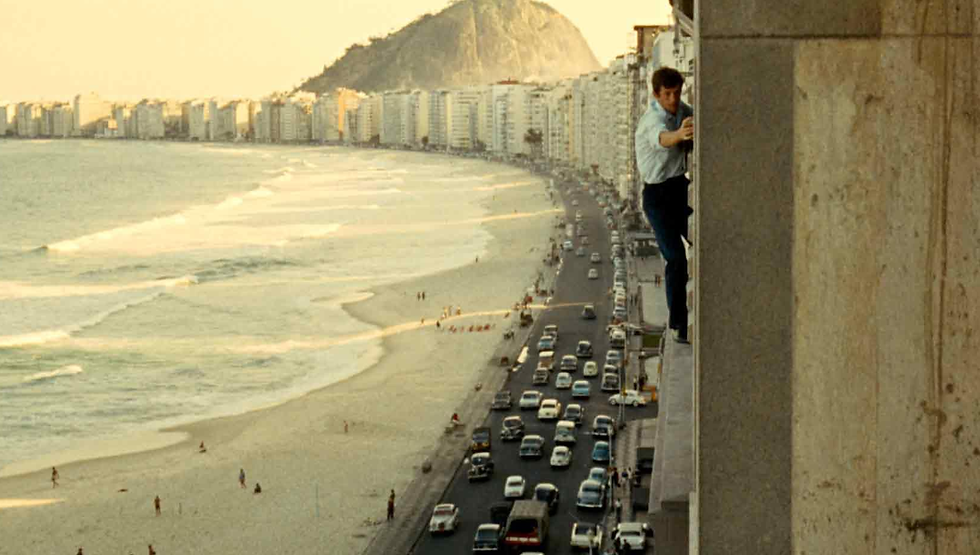
The true highlight of ‘That Man from Rio’, however, is its extraordinary stunt work. As Dufourquet, Jean-Paul Belmondo literally throws himself into the role with astonishing commitment, performing many of his own stunts with a fearless enthusiasm that makes every sequence feel genuinely dangerous. Whether scaling buildings, parachuting from aeroplanes or racing through elaborate chase sequences, Belmondo brings a level of physicality that few actors of the era could match. There is also a palpable sense of whimsy to the action; set pieces as playful as they are dangerous.
The influence of silent comedy is clear throughout, particularly in the way de Broca stages movement and space. Like Keaton and Lloyd before him- and Chan afterwards- Belmondo is not simply surviving these situations- he is performing a carefully choreographed dance with danger. The result is action that remains thrilling not because of spectacle alone, but because of the sheer personality and skill behind every stunt.

Alain Delon once said “Belmondo is the audience’s friend”. Nowhere is that more evident than in his performance as Dufourquet. He brings an easy charm to the role, creating a hero who is brave and resourceful but never too polished or invincible. His reactions, comedic flair and willingness to throw himself into danger make Dufourquet a likeable protagonist; an ordinary man swept into extraordinary circumstances.
However, the film would not work nearly as well without Françoise Dorléac. As Agnès, she is far more than a damsel in distress, matching Belmondo's energy with her own charisma and wit. Dorléac brings intelligence, confidence and a playful spirit to the role, making her partnership with Belmondo one of the film's greatest strengths. Their chemistry gives the film a romantic warmth beneath all the chaos, ensuring audiences remain invested in their journey.

The supporting cast further enhances the film's charm. Jean Servais brings a commanding presence to the role of Professor Catalan, while Adolfo Celi appears to be having a ball as de Castro, embracing the film's larger-than-life tone with a wonderfully theatrical performance. Elsewhere, Ubiracy De Oliveira’s Sir Winston- a young shoeshine boy who becomes caught up in the journey- is a joy to watch. With his expressive reactions and infectious energy, De Oliveira does most memorable work.
Philippe de Broca's ‘That Man from Rio’ is a reminder of the simple pleasures that make cinema so magical. It may not reinvent the adventure genre, but few films capture its spirit with such breezy confidence. Powered by Belmondo's charisma, Dorléac's brilliance and de Broca's boundless imagination, it remains a joyous, breathless and endlessly entertaining piece of filmmaking. More than sixty years later, its influence can still be felt- a reminder that the greatest films are not defined solely by where they take us, but by the joy of the journey itself.


