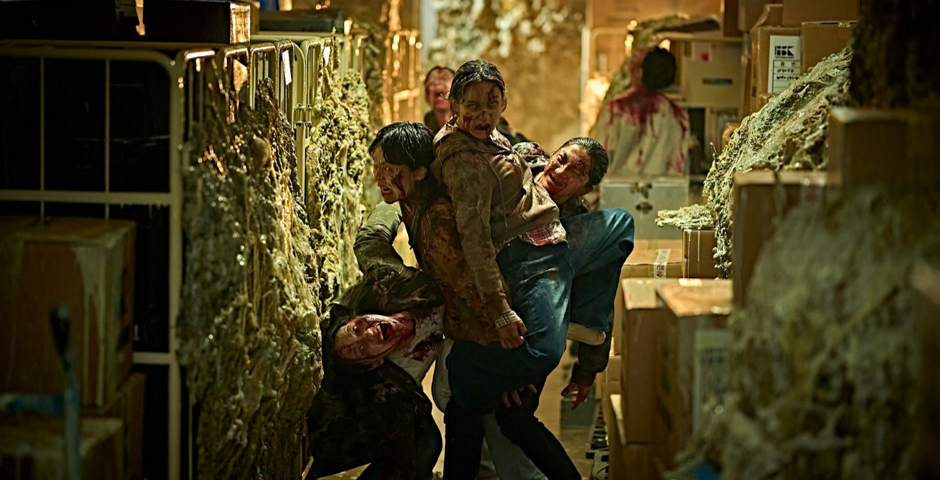
Hokum (2026) Review

Damien McCarthy’s love of horror was forged in the aisles of his father’s video rental shop in 1980s West Cork. Surrounded by the lurid box art and forbidden mystique of VHS-era horror, McCarthy developed the sensibilities that would later define him as a filmmaker. His early work quickly earned critical attention for its eerie atmosphere, establishing him as one of Ireland’s foremost modern horror voices.
With ‘Hokum’, McCarthy once again channels the genre obsessions that shaped him, crafting a film steeped in the strange, tactile spirit of the movies he grew up devouring. It follows brusque American writer Ohm Bauman, who travels to a hotel in rural Ireland to scatter his parents’ ashes and finish his latest novel. Once there, he becomes entangled in an unsettling web of local hostility and supernatural menace, from which he may never escape.

‘Hokum’ is, for this reviewer anyway, a challenge; an effectively made genre piece that is both engaging and frustrating. Its human horrors are genuinely disturbing, while the film’s folkloric elements possess an eerie power of their own. Yet the two rarely operate in harmony. Unlike the best psychological ghost stories, where internal and external terrors reflect one another, ‘Hokum’ feels pulled between conflicting impulses, leaving its individual scares effective, but the overall experience oddly fragmented.
The film’s strongest sequences are often its simplest: awkward conversations stretched to breaking point, hints of long-buried trauma, the persistent sense that Ohm is trapped among people whose friendly exteriors mask darkness. Yet, just as the film begins to build genuine psychological, human-centric tension, McCarthy introduces increasingly elaborate paranormal mythology that, rather than intensifying the dread, shifts the story onto a less compelling wavelength.

This imbalance is not the result of underdeveloped ideas- in many ways, the occult dimension is the film’s most imaginative aspect. Rather, ‘Hokum’ falters because its supernatural elements seldom complement the more intimate terror surrounding Ohm. Although both well-executed, the film’s two distinct strains of horror never fully coalesce, resulting in a work that is atmospherically rich and consistently intriguing, yet emotionally unfocused.
Is it a ghost story seeped in Gaelic mythology? A horror about a killer hiding in plain sight? A kind of Irish ‘Zerograd’ or ‘Local Hero’ mingled with ‘The Shining’? Ultimately, ‘Hokum’ is all of the above and more- and its narrative weight is diminished by McCarthy’s refusal to fully commit to any one of these directions.

However, whatever shortcomings the film may have narratively, they are frequently offset by McCarthy’s command of atmosphere and visual space. ‘Hokum’ is a remarkably handsome piece of filmmaking, with cinematographer Colm Hogan and production designer Til Frohlich transforming what is essentially a single setting into something genuinely uncanny. Corridors seem to stretch endlessly into darkness, rooms feel weighed down by time gone by- every creaking floorboard, eerie fixture and flickering light contributing to the sense that the building itself is something to be feared.
Indeed, McCarthy and his collaborators make striking use of the confined location, with Frohlich’s production design doing much of the heavy lifting in constructing an authentic, oppressive world. Brian Philip Davis’s editing allows tension to accumulate in long, suffocating beats before snapping into sudden disruption. In short, even when the narrative threatens to lose focus, the film’s visual and spatial control rarely does.
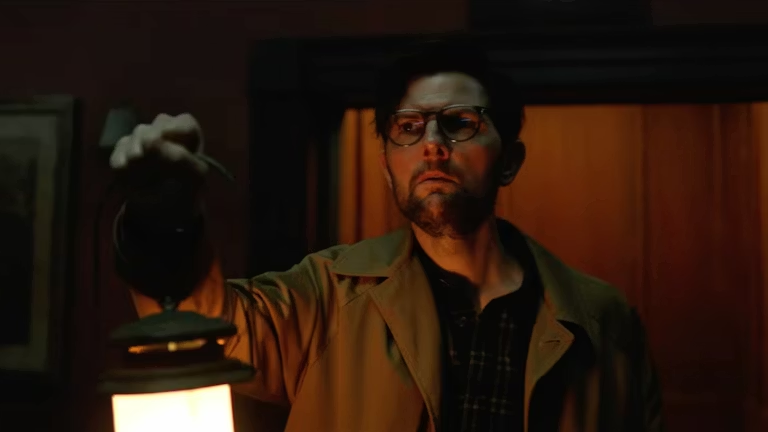
As Ohm, Adam Scott gives a powerfully restrained performance. Instead of leaning on the familiar trope of the arrogant outsider in a small, country village, he brings nuance to the role. Even in moments of calm, Scott sustains a low hum of unease, making Ohm someone whose past keeps him perpetually braced for impact. His supporting cast do similarly interesting work, particularly Florence Ordesh, Peter Coonan and David Wilmot.
Damien McCarthy’s ‘Hokum’ is most compelling in fragments rather than as a whole. The assured direction, alongside strong work from cast and crew, produces moments of genuine dread and striking visual invention. Yet, it never quite finds a stable emotional or narrative centre; its impact powerful in parts, but diluted overall. Ultimately- and unfortunately- it is aptly-titled: ‘Hokum’ by name and nature.