


Colony (2026) Review
Updated: Aug 7
Sometimes, a director's greatest success becomes their biggest burden; a benchmark every subsequent work is forced to confront. Although he arguably made better films later in his career, Orson Welles spent a lifetime living in the shadow of ‘Citizen Kane.’ Steven Spielberg's ‘Disclosure Day’ was inevitably measured against his earlier science-fiction classics (and found wanting), while M. Night Shyamalan’s work has rarely been allowed to escape comparisons to ‘The Sixth Sense.’
‘Train to Busan’ director Yeon Sang-ho finds himself in that uncomfortable position now with ‘Colony.’ Inside a locked-down skyscraper, the film follows Kwon Se-jeong, an unemployed biology professor searching for a second chance, whose visit to a corporate presentation turns into a fight for survival. When a disgruntled scientist unleashes a mutated slime mould as part of a bio-terrorist attack, the building becomes ground zero for a zombie outbreak. Trapped inside alongside a group of civilians, Se-jeong must use her scientific knowledge to outsmart an intelligent, evolving threat unlike anything the world has ever seen.

On paper, it’s an intriguing concept: ‘Die Hard’ meets ‘Dawn of the Dead’, with a dash of evolutionary biology science-fiction. Rather than simply creating another wave of mindless undead, Yeon and co-writer Choi Kyu-seok imagine an infection that allows hosts communicate, leading the creatures to learn, adapt and evolve. It is a clever extension of zombie mythology, and the film's first act is quite strong, full of exciting, tense moments, as we are introduced to this new threat.
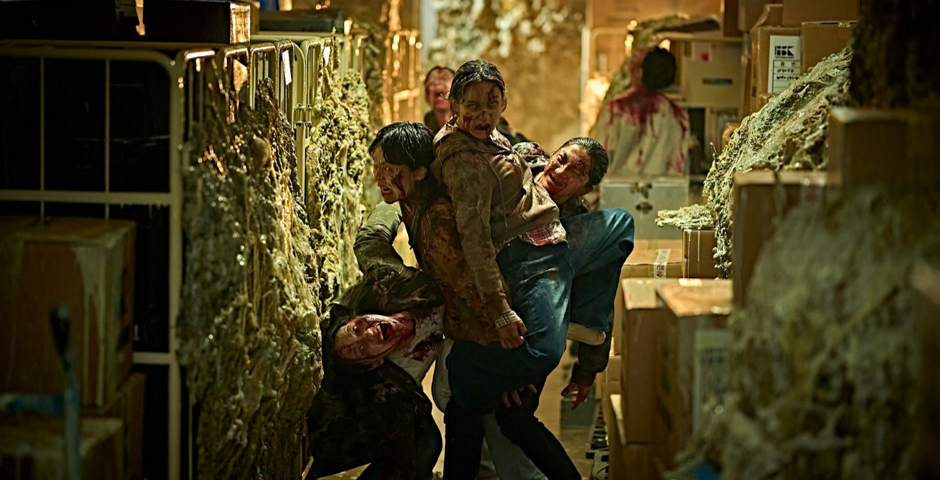
Early on, Yeon finds inventive ways to explore this idea. The survivors use scents to distract the infected, creating some tense and unusual encounters, while one particularly unsettling moment sees the creatures mimic the way a security guard carries his wheelchair-bound sister, suggesting they are observing and learning from human behaviour. In these moments, it feels as if ‘Colony’ is pushing the zombie genre somewhere new.

Unfortunately, ‘Colony’ never fully capitalises on its concept. The infected's evolving intelligence should make them one of the most frightening forces in recent horror, yet Yeon doesn’t really explore the implications of this ability beyond its immediate action sequences. The human antagonist is similarly underwhelming, lacking the presence or complexity needed to match the scale of the virus he has unleashed and controls. In fact, aside from the security guard and his sister, the human characters don’t leave much of an impression.
There are still moments of impressive zombie violence, and the film occasionally captures the chaotic energy expected from Yeon Sang-ho. Yet its greatest weakness is unavoidable: Yeon directed ‘Train to Busan,’ quite possibly the best zombie film of all time. In comparison to that genre masterpiece, ‘Colony’ seems like a conventional action-horror, albeit with an intriguing core idea about evolution and a hive-mind intelligence.

Yeon’s previous film succeeded not only because its zombies were relentless, but because its characters were people the audience genuinely cared about. Its infected were terrifying because they represented a loss of humanity, not merely a physical threat. At any point, one of the characters you had grown to care about could- and probably would- get bitten. It was riveting. Tension, comedy, heart, drama, violence- ‘Train to Busan’ had everything but the kitchen sink- and that was probably in there too, somewhere.
In ‘Colony’, the creatures are certainly unsettling (although their exaggerated movements recall the choreography of David Bowie's ‘Blackstar’ music video). That’s kind of all there is to it, though- it has the bite, but not the heart. After the first act, the narrative loses steam and the tension gradually dissipates. For a film built around an evolving organism capable of adapting to human behaviour, it often feels surprisingly predictable.

Visually, however, ‘Colony’ is a polished production. Yeon stages the action with impressive clarity and energy, giving the set pieces a real sense of momentum. One short sequence in particular, set in a laboratory with infected monkeys, is genuinely creepy. Byun Bong-sun’s cinematography is slick without becoming overly sterile, while Kim Hyun-jung’s make-up effects are generally effective, creating a suitably grotesque vision of infection.
The production design also makes effective use of the film’s contained setting. The Dongwoo-ri skyscraper gradually transforms from a polished corporate environment into a chaotic battleground, with offices, shopping areas and corridors becoming consumed by the outbreak. This gives the film a strong sense of scale despite its limited location, allowing Yeon create a convincing survival arena for the characters.

Conversely, the white fungal-like secretion covering the infected and spreading across the building is a bit problematic. Although an interesting visual idea, suggesting the organic nature of the outbreak, it occasionally veers into looking artificial. In some particularly well-lit shots, the substance plastered across walls, costumes and surfaces appears like beige silly string spray, weakening the atmosphere the film is trying to create.
The sound design and score are similarly effective in places. The music is often suitably stirring, adding weight to the film’s larger moments and reinforcing the scale of the outbreak. However, the low, ominous blast that accompanies the infected’s communication is repeated so often it rapidly loses impact (making one think that sound designer Kim Sok-won must have really loved that ‘Inception’ noise). The editing, meanwhile, is serviceable if unremarkable. The action sequences are easy to follow and fun to watch, but outside of these moments the pacing begins to suffer, particularly after the strong opening act.

The performances are generally solid, even if the material does not always give the actors much to work with. Jun Ji-hyun makes for a capable lead as Kwon Se-jeong, bringing a quiet determination to the role, although the character itself feels rather one-dimensional. Shin Hyun-been also has several strong moments as the wife of Se-jeong’s ex-husband.
The standouts, however, are Ji Chang-wook and Kim Shin-rok as the security guard and his wheelchair-bound sister. Their relationship provides some much-needed emotional weight, bringing a sense of humanity that the rest of the film lacks. Koo Kyo-hwan is also effective as the antagonist, delivering a suitably unsettling performance, despite the role being underwritten.

Overall, Yeon Sang-ho’s ‘Colony’ is like a bite from a dog with rubber teeth- a bit frustrating, but hardly a killer. Boasting an imaginative zombie concept and some exciting sequences, as well as strong performances, it contains flashes of the filmmaker who made the terrifyingly terrific ‘Train to Busan’. However, without the emotional investment and human drama that powered that earlier masterpiece, Yeon’s clever ideas never fully develop. For a film about evolution, the greatest irony is that ‘Colony’ never truly evolves beyond the shadow of what came before.


