


Giants & Toys (1958) Review

Few Japanese directors were as restless as Yasuzō Masumura, whose route into filmmaking was unusually circuitous. After studying law and philosophy at the University of Tokyo and working at Daiei, he travelled to Italy to learn from Federico Fellini, Luchino Visconti and Michelangelo Antonioni. Back in Japan, he refined his craft under the likes of Kenji Mizoguchi and Kon Ichikawa before debuting with ‘Kisses’ in 1957, a film prompting Nagisa Ōshima to proclaim, “A powerful irresistible force has arrived in Japanese cinema.”
Ōshima wasn't exaggerating. Over the next three decades, Masumura directed 58 films across a remarkable range of genres, yet all bearing the same signature: bold, provocative and fiercely sceptical of social conformity. Released just a year after ‘Kisses’, ‘Giants & Toys’ is one of the purest expressions of that rebellious spirit. A blistering satire of post-war consumerism, advertising and corporate ambition, it's a film that feels every bit as chaotic, cynical and contemporary today as it did in 1958.

‘Giants & Toys’ is set in the cutthroat world of confectionery advertising, where manufacturer World battles rival companies Giant and Apollo for control of the caramel market. When advertising chief Goda discovers Kyôko, a working-class girl with stained teeth, he turns her into an unlikely star and the face of World's latest campaign. As Kyôko's popularity soars, Goda's assistant Nishi embarks on an affair with Apollo's advertising executive, Kurahashi. With corporate rivalries intensifying and Kyôko becoming increasingly independent, Goda's schemes spiral out of control.
Based on a novel by Takeshi Kaikô, with a screenplay from Yoshio Shirasaka, it is a gloriously frantic satire of capitalism. Corporate competition is treated as a kind of madness, with World, Giant and Apollo locked in an escalating battle where market share matters more than human beings. Employees are expendable assets, consumers are targets and even a young woman like Kyôko can be transformed into a walking advertisement. Masumura takes particular aim at the machinery of media and public relations, where image is everything, authenticity merely another obstacle to overcome. If there is a weakness, it is the ending, which feels somewhat abrupt after the film’s increasingly manic build-up; but the journey there is a wild one.
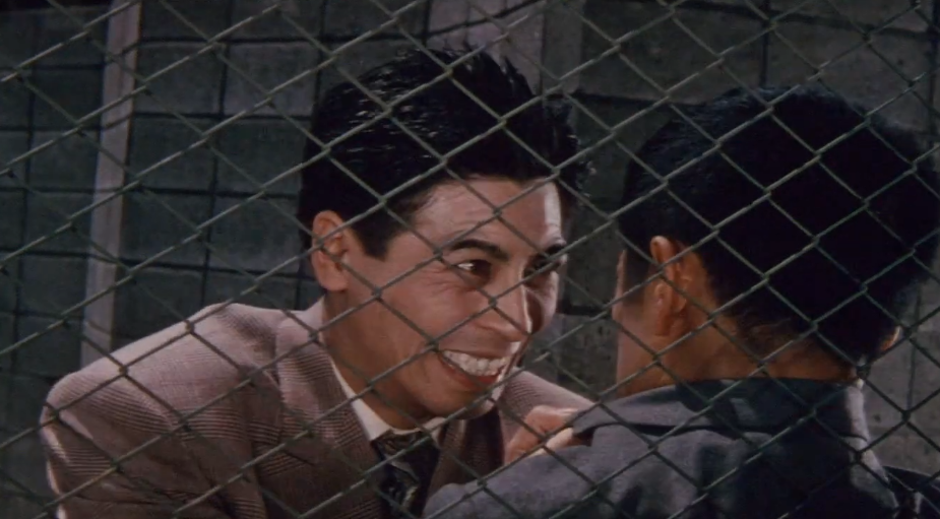
While it’s a sharply funny film, beneath the humour is something considerably more pointed. ‘Giants & Toys’ captures a society hurtling towards mass consumerism, where branding, spectacle and relentless ambition have become almost indistinguishable from progress. Like Yasujirō Ozu’s films, it depicts a post-war Japan increasingly shaped by Western ideals: business suits and summer dresses, fizzy drinks and plastic toys; symbols of a rapidly changing society.
However, where Ozu often viewed this Americanised homogenisation with melancholy, Masumura attacks it with manic energy. His characters desperately scramble for success, sacrificing their dignity, relationships and, eventually, sense of self in the process. The result is a world both exhilarating and insane- a corporate machine running at full speed, with nobody quite sure where it’s going.

The sharp dialogue and astute characterisation give proceedings plenty of bite. There are many laughs throughout, with the characters’ increasingly desperate actions being funny but, oddly, believable. Masumura’s heightened depiction of the fast-paced world of business makes for excellent satire. It is this balance keeps ‘Giants & Toys’ from becoming a dry critique of capitalism; Masumura is having far too much fun tearing the whole thing apart.
A strikingly clean-looking film, it bursts with vibrant colours and crisp compositions. Cinematographer Hiroshi Murai’s camera moves like a caffeinated executive, darting through offices and streets with barely a moment to breathe, while his colours scream like advertising copy. Everything is polished, artificial and relentlessly energetic, perfectly reflecting a world where ambition is weaponised and individuality is a liability.
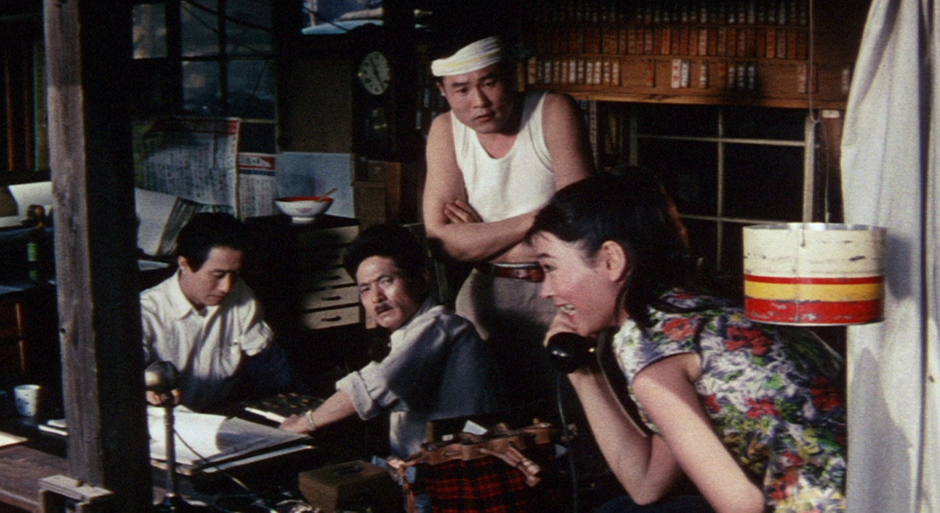
Tatsuji Nakashizu’s editing is just as lively, playing around with rhythm. Frequently, as Goda struggles with his cigarette lighter, brief montage sequences are superimposed over the image- a strange little flourish perfectly capturing the film’s restless, stylish visual language. Adding to the frenzy is Tetsuo Tsukahara’s jazzy, stirring score, giving proceedings an extra jolt of energy.
As Nishi, Hiroshi Kawaguchi delivers a solid performance as an ultimately decent man working in a business that has little use for morality. Hideo Takamatsu, meanwhile, is terrific as Goda, the film’s human embodiment of capitalism and a new breed of businessman: one unconcerned with honour or corporate loyalty, interested only in the bottom line. Hitomi Nozoe is equally good as Kyôko, convincingly charting her transformation from an innocent young woman into someone increasingly emboldened by her newfound fame. Elsewhere, Michiko Ono and Yūnosuke Itō are both terrific as the aforementioned Kurahashi and seedy photographer Harukawa.
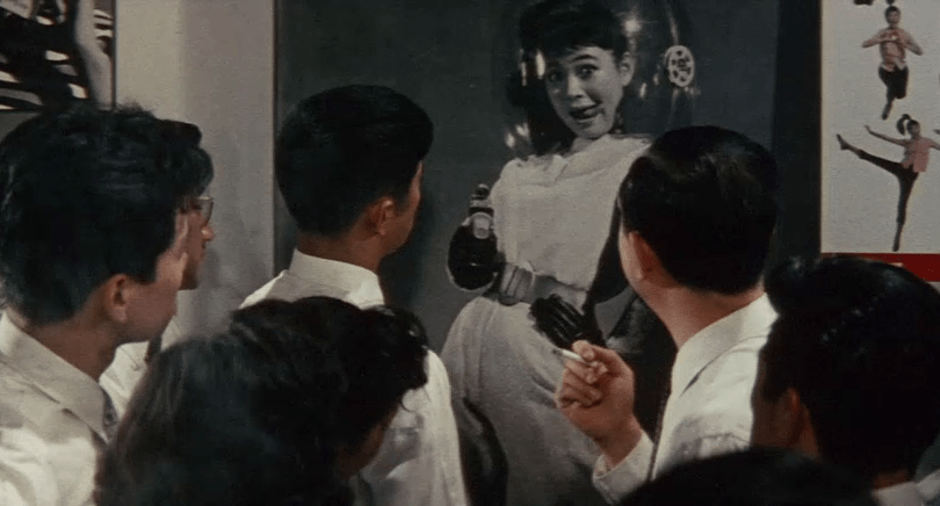
Yasuzō Masumura’s ‘Giants & Toys’ is the work of a director who understood the machinery of modern life all too well and refused to let it grind quietly in the background. Sharp, funny and visually striking, it is a wonderfully caustic satire of capitalism, consumerism and the endless pursuit of success. More than six decades later, its vision of a world where everything- and everyone- can be turned into a commodity still feels startlingly relevant. In short, ‘Giants & Toys’ may be about the monstrous machinery of capitalism, but Masumura makes playing with it monumentally fun.


