


28 Years Later: The Bone Temple (2026) Review

In 2025, Danny Boyle resurrected the ‘28 Days Later’ franchise with ‘28 Years Later’, a bold addition that split audiences straight down the middle. Plenty of viewers embraced its ambition and found it a gripping, atmospheric return to the Rage-infected world, but others were far less convinced. For some, the film’s bleak mood felt oppressive, its runtime indulgent and its somewhat restrained approach to gore a disappointing departure from the series’ feral energy.
Almost exactly six months later comes Nia DaCosta’s follow-up: ‘28 Years Later: The Bone Temple.’ It continues where the last entry left off, with our intrepid young hero Spike now on the mainland running with Sir Lord Jimmy Crystal’s gang of Satan-worshipping sadists. Meanwhile, Dr. Kelson’s ongoing research into the outbreak yields surprising results that threaten to reshape the world in ways nobody could expect.

It is a different beast from its predecessor: sharper, stranger and far more human. It’s also more entertaining, embracing a streak of anarchic humour that keeps it unexpectedly light on its feet even as the stakes grow darker. Alex Garland delivers a story that crackles with energy, while DaCosta’s assured direction binds its wild tonal shifts into something cohesive and compelling.
What makes ‘The Bone Temple’ so striking is the way it balances its extremes. It moves effortlessly between horror and humanity, comedy and violence, without ever feeling disjointed. Its wildest element- the unhinged, almost theatrical psychopathy of Sir Lord Jimmy Crystal and his troupe- is played with such manic conviction that it’s both terrifying and darkly funny. Their unsettling brutality borders on the gorily absurd, yet never slips into parody; instead heightening the film’s unpredictability.

This chaos is counterweighted by Dr. Kelson, whose storyline provides the film’s emotional anchor. His attempts to communicate with, and help, Samson- an “alpha infected” whose behaviour challenges everything we thought we knew about the Rage virus- brings a surprising tenderness to the narrative. Their scenes are patient, gentle and often warmly funny, offering a vision of connection in a world defined by fear. The contrast between Jimmy’s gleeful cruelty and Kelson’s compassion is what makes the horror meaningful.
Kelson’s storyline quietly examines whether empathy can survive in a world governed by carnage. His determination to see Samson not as a monster but as a being still capable of connection is the film’s most radical gesture. In a landscape where ferocity is the default language, Kelson’s insistence on compassion feels almost subversive- a refusal to surrender to the moral erosion around him. These moments give proceedings a philosophical weight, suggesting that humanity’s survival depends not just on endurance, but on the belief that understanding is still possible, even when everything else has fallen apart.

Critics of its predecessor who yearned for more gore will not be let down. ‘The Bone Temple’ is frequently graphic and intense in its violence, with exceptional choreography, makeup and practical effects work. Wounds, fight scenes and Rage‑infected contortions have a tactile, unsettling realism, making every encounter land with force. Blood and guts literally fly. DaCosta leans into the physicality of the infected in a way the previous film only hinted at. The visceral brutality serves the story, emphasising the chaos of Jimmy’s gang and the growing humanity of Samson in equal measure.
Visually, Sean Bobbitt’s cinematography gives proceedings an arresting, lived‑in texture. Locations feel genuinely ravaged- damp, rusted, overgrown spaces life has completely abandoned. Bobbitt leans heavily on handheld camerawork, amplifying the tension and unpredictability of every encounter; the frame jitters and sways, pulling the audience directly into mayhem and madness.
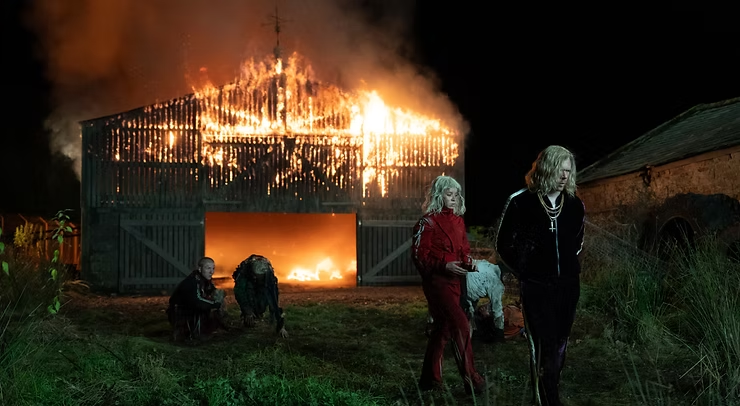
Yet for all its grit, this is also a strikingly composed film, filled with powerful, lingering images: silhouettes against raging fires, the eerie stillness of Kelson’s Bone Temple and moments of quiet beauty punctuating the pandemonium. Carson McColl and Gareth Pugh’s production design and Bobbitt’s cinematography work in perfect tandem, creating a world that feels both real and mythic in its decay.
It is an assault on the senses, not just visually but aurally too. The sound design is razor‑sharp, layering snarls, screams and environmental noise into a dense, nerve‑jangling tapestry keeping the audience on edge. Just as crucial is the film’s use of silence and ambient sound. DaCosta knows exactly when to strip the soundscape back to nothing but wind, rustling leaves, or the distant shuffle of the infected- moments that make the eventual eruptions of savagery even more shocking. Hildur Guðnadóttir’s score is atmospheric and unsettling, pulsing beneath the action with a sense of dread that never overwhelms the quieter beats.

The soundtrack choices are similarly inspired. The film makes striking use of tracks by Iron Maiden, Radiohead and others. Additionally, in a moment that will thrill longtime fans, John Murphy’s iconic “In the House, In a Heartbeat” is deployed during the finale with electrifying precision- a perfect marriage of nostalgia and escalation, reconnecting the film to its origins while opening the door to even bolder possibilities. Jake Roberts’ editing complements all of this beautifully, cutting with a rhythm that heightens tension without sacrificing clarity.
As Kelson, the inimitable Ralph Fiennes once again demonstrates why so many consider him the finest actor working today. He brings compassion, humour and a quiet, searching empathy to the role, anchoring the narrative’s grander ideas in small, truthful moments. Chi Lewis‑Parry is equally compelling as Samson, delivering a powerful, physically imposing performance layered with vulnerability and nuance; his scenes with Fiennes are among the film’s most affecting.

Alfie Williams continues to impress as Spike, astutely capturing the character’s fear and creeping disillusionment, while Erin Kellyman brings a sharp edge to her role as Kelly, one of Jimmy’s followers. Further, the closing moments feature a brief appearance from a familiar figure - a harbinger and tease that this series has more bedlam in store for the future.
If the film’s heart belongs to Fiennes and Lewis‑Parry, its wild, unpredictable pulse comes from Jack O’Connell. As Sir Lord Jimmy Crystal, he is fantastically unhinged- electric, volatile and utterly deranged. It’s a performance that teeters on the brink of chaos without ever losing control, embodying the film’s blend of theatricality and terror. O’Connell’s scenes crackle with danger; his presence injects the narrative with a manic energy, keeping the audience perpetually off balance.

For all its mayhem, melancholy and madness, Nia DaCosta’s ‘28 Years Later: The Bone Temple’ stands as a bold, invigorating reminder that this franchise still has fresh blood in its veins. DaCosta and Alex Garland push the series into stranger, richer territory without losing sight of the raw humanity that made it endure in the first place. It’s an engaging picture that thrills, unsettles and surprises in equal measure. Sir Lord Jimmy Crystal often asks his followers, “How’s that?” In the case of Nia DaCosta’s ‘28 Years Later: The Bone Temple’, the answer is simple: bloody brilliant.


