


Send Help (2026) Review

Stories of isolation and survival have long served as mirrors for the societies that produce them. First published in 1719, Daniel Defoe’s ‘Robinson Crusoe’ set the template for the lone castaway wrestling with both nature and self. Later works, from J. M. Barrie’s ‘The Admirable Crichton’ to William Golding’s ‘Lord of the Flies’, used the desert-island scenario to interrogate class, authority and the ease with which social order gives way to brutality. By the late 20th century, the castaway narrative had taken on explicit political weight: John Boorman’s ‘Hell in the Pacific’ distilled the form into an anti-war parable, trapping two enemy soldiers together and forcing a cooperation which exposed the futility of conflict.
In more recent incarnations, the genre has narrowed its focus towards the intimate mechanics of human endurance, personality and power. Sam Raimi’s darkly comic ‘Send Help’ offers a contemporary twist on the castaway story, stripping the scenario down to its most volatile element: two people who are far less equipped to survive one another than the island they’re stuck on.

It follows Linda Liddle, a capable but undervalued professional whose arrogant superior, Bradley Preston, belittles at every turn. Her male colleagues take credit for her work, reinforcing a patriarchal corporate hierarchy that consistently leaves her sidelined. On the way to Bangkok, their plane crashes and Liddle and Preston find themselves stranded on a remote island, forced to confront not only the challenges of the wild, but each other. Who’s the boss when the hierarchy is gone and only instinct remains?
Written by Damian Shannon and Mark Swift, ‘Send Help’ is engaging and tightly scripted, anchored by characters who feel believable and fully realized. Liddle and Preston share a dynamic that rings true: her competence and understated frustration contrast sharply with his arrogance and entitlement, creating a friction that powers the narrative.

Once stranded on the island, Preston’s usual confidence and sense of superiority quickly prove comically ineffective; he is forced to rely on Liddle, whose practical skills and calm judgment emerge as the real tools for survival. The film subtly critiques corporate “bro” culture and the kind of frat-boy arrogance that can dominate certain workplaces, showing how these patriarchal attitudes are ultimately unfit for the real challenges of life.
Liddle, meanwhile, undergoes a satisfying arc of personal growth. Away from the confines of the corporate jungle, her awkwardness diminishes and she develops confidence in her own abilities, discovering a resourcefulness and self-assuredness that were previously overshadowed. Further, Shannon and Swift’s dialogue captures how people actually speak, with humour and tension that feel natural rather than expository.

Only in the third act does the narrative falter slightly, when an unnecessary twist muddies the otherwise clear trajectory. Even so, the interplay between the two leads remains compelling, and the film succeeds in making you understand not just who they are, but why they behave as they do. Throughout, the laughs come fast and dark, emerging from chaotic set-pieces, mischievous antics and the sharp dynamics between the pair, all delivered in true Raimi fashion.
It is unmistakably a Sam Raimi picture. Classic moments of over-the-top humour, inventive gore and escalating madness work in tandem with sequences where the natural environment is used to generate unease, echoing the techniques that made ‘The Evil Dead’ films so effective. Rain, shadows and gargantuan trees are active instruments of suspense, amplifying the atmosphere of isolation and dread. Raimi’s signature frantic POV shots- whip-like camera sweeps tracking characters through space- appear, maintaining energy while showcasing Raimi’s playful yet precise command of visual storytelling.

Bill Pope’s cinematography is striking, immediately immersing the viewer in the film’s world. The framing of the environment- dense foliage, crashing waves, wide, open stretches of sand- emphasizes both isolation and vulnerability, while extreme close-ups heighten tension. At one point, there is a subtle nod to ‘Hell in the Pacific’: the two characters stand on opposite sides of the frame, the vast expanse of beach between them visually signalling the emotional and psychological distance separating them.
Ian Gracie’s production design, alongside the makeup, costume design and practical effects, work seamlessly with Pope’s lensing, creating a world in which gore, filth and chaos feel immediate. Danny Elfman’s score punctuates the action with a mix of whimsy and menace, accentuating both the film’s comedically acidic tone and its moments of genuine intensity. Additionally, Bob Murawski’s editing is sharp and energetic. The film flies by at a fast pace.
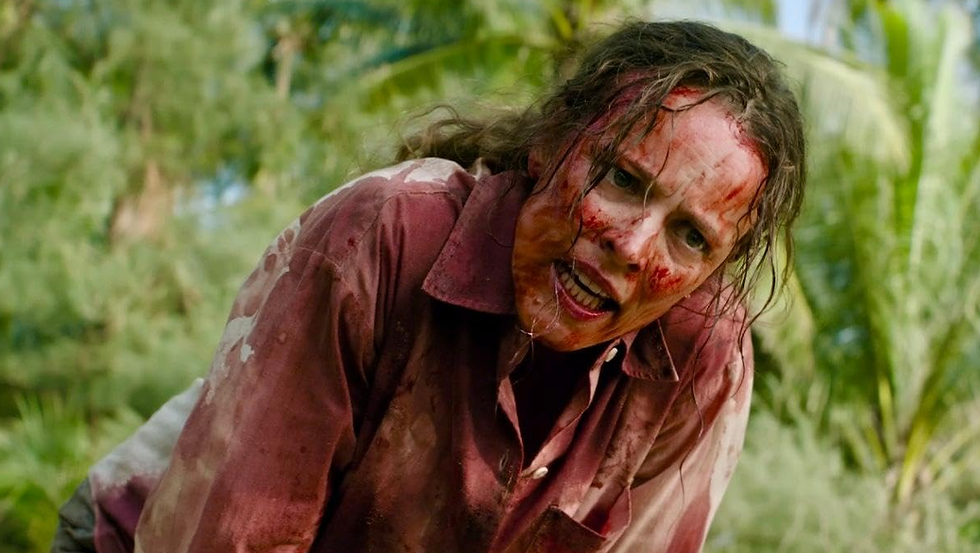
Rachel McAdams has rarely been better, bringing to life Liddle’s awkward charm, emerging confidence and sharper, darker edges. She navigates the film’s comedic bedlam and tense moments with ease, delivering a performance that’s as funny as it is grounded. Dylan O’Brien perfectly captures Preston’s smugness and entitlement, while subtly revealing the cracks in his overconfidence. His performance balances arrogance with vulnerability, making the character both infuriating and oddly relatable; the perfect foil for McAdams’ Liddle.
‘Send Help’ is a wild ride full of pitch-black humour, proving Sam Raimi hasn’t lost his touch. The film balances character-driven storytelling with outrageous set-pieces, inventive action and a kinetic visual style that keeps every scene brimming with tension and absurdity. Strikingly shot, strongly acted and boasting a stirring score, it’s a lean, inventive genre piece that understands exactly when to excite, when to amuse and when to do both at once. In the end, ‘Send Help’ needs no rescue; as a piece of filmmaking, it’s anything but lost.


