


Exit 8 (2025) Review

Video games are notoriously difficult to adapt. For years, Hollywood seemed convinced that the title alone was enough- that a recognisable IP could compensate for an underwhelming narrative. From the confused Mark Wahlberg-led ‘Max Payne’, to Justin Kurzel’s dour ‘Assassin’s Creed’ and too many questionable Uwe Boll efforts to count, video game movies became synonymous with missed potential- and, more often than not, projects that didn’t work even on their own terms, regardless of their underlying inspiration.
Only recently has that started to change. Shows like ‘Fallout’ and ‘The Last of Us’ have found success with both gaming audiences and general viewers, made by people who actually seem to care about their source material. Genki Kawamura’s ‘Exit 8’ fits neatly into this category. Based on Kotake Create’s indie horror of the same name, it follows a man trapped in a nightmarishly looping subway corridor, who must identify differences, or “anomalies,” in each cycle in order to escape.

It’s a fiendishly simple premise, making for a devilishly effective picture, that assuredly stands on its own two feet. Confidently directed by Kawamura, the film is- by its very nature- repetitive. However, it is never dull. Its stripped-back structure produces moments of great unease, as the audience is drawn into the same observational game as the protagonist. Though never outright frightening, the film sustains a creepy, sinister atmosphere truly setting it apart. Further, Kawamura and co-writer Kentaro Hirase make the narrative unexpectedly rich in subtext.
The protagonist- known only as “the lost man”- is caught in both physical and emotional limbo. The subway corridor becomes a manifestation of his uncertainty about the future. Unsure whether to become a father, many of the most unsettling anomalies he encounters seem to reflect that anxiety: disembodied infant cries echoing from lockers, a torrent of water separating him from a boy trapped beside him in the loop.

Keisuke Imamura’s cinematography is atmospheric and immersive. It opens in a first-person perspective mirroring the video game, before shifting into more conventional framing- yet never loses its sense of immediacy. Art director Ryo Sugimoto, alongside the production design team, craft a menacingly sterile world where clinical precision feeds directly into the film’s off-kilter tone and sense of uncanny disorientation. Even the smallest change- a poster subtly altered, a door handle moved to one side- registers as an intrusion into an otherwise rigid visual order, forcing both the lost man and the viewer into an increasingly unstable act of comparison and recall.
The sound design and score are equally effective, building a low, persistent sense of disquiet, sitting just beneath the surface of each loop. Silence is used just as deliberately as noise, making small auditory disruptions feel significant and destabilising. The use of Ravel’s Boléro is particularly striking, its repetitive structure echoing the film’s own cyclical form while gradually intensifying its sense of inevitability. Sakura Seya’s editing reinforces this rhythm, emphasising repetition without dulling its impact.
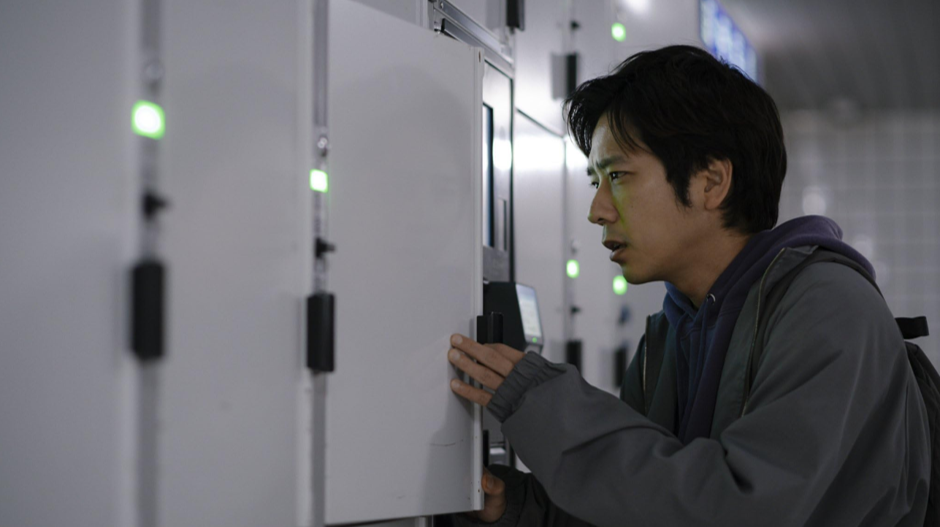
The performances are uniformly strong and deliberately restrained. Expression is pared down to small gestures and micro-reactions, as much of the storytelling depends on observation rather than dialogue. As the lost man, Kazunari Ninomiya is especially compelling, conveying mounting disorientation and quiet psychological strain through subtle, controlled physicality, while Yamato Kochi and Naru Asanuma provide understated but effective support.
Genki Kawamura’s ‘Exit 8’ ultimately stands as a compelling example of what a video game adaptation can be when it trusts its source material’s core ideas rather than its surface trappings. Stripped of spectacle, it finds tension in repetition, observation and atmosphere, proving that even the simplest concepts can sustain a full cinematic experience when handled with precision and control. Though never terrifying, it is strongly acted and engaging throughout. In short, ‘Exit 8’ is one you’ll want to play again.


