


Absolution (1978) Review
Updated: Aug 7

For a time, Richard Burton was practically a God. However, after reaching the height of his film career in the mid-1960s, his fortunes began to decline. A series of commercial disappointments and changing audience tastes diminished his standing as one of Hollywood's leading stars. Although still capable of delivering powerful performances, his career never fully regained the momentum of its earlier peak.
It was during this period of professional uncertainty that Burton took on ‘Absolution’, a psychological thriller directed by Anthony Page, from a screenplay by Anthony Shaffer, John Bowen and Richard O'Keefe. Burton stars as Father Godden, a priest and teacher at a Catholic boarding school who becomes obsessed with uncovering the truth behind a student, Benjie’s, confessions. As his investigation deepens, he is drawn into a disturbing web of deception, guilt and psychological manipulation, challenging his faith and authority.

It is one of the better Burton vehicles of the 70s, not as good as Sidney Lumet’s ‘Equus’, but a world away from the likes of ‘The Klansman’ and ‘The Medusa Touch’. A suspenseful and atmospheric, though melodramatic piece, the narrative constantly leaves the audience questioning who is telling the truth. Shaffer, Bowen and O'Keefe's dialogue is strong, for the most part, while their characterisation is nuanced, particularly in the increasingly complex relationship between teacher and pupil. As questions of guilt, deception and morality emerge, the line between victim and manipulator becomes increasingly blurred.
In many ways, the film follows in the tradition of psychological thrillers such as Francis Ford Coppola's far more accomplished ‘The Conversation’, where the search for truth becomes an obsession in itself. Father Godden believes that uncovering the reality behind Benjie's confession will restore order, yet the deeper he investigates, the more uncertain everything becomes. Unlike traditional religious dramas, where faith often provides clarity and redemption, ‘Absolution’ presents belief as something fragile, with Godden's rigid moral framework gradually collapsing.

The boarding-school setting further enhances the film's atmosphere of repression and secrecy, while also allowing the story to question the authority figures who claim to provide guidance. However, the film has undeniable pacing issues, and while a number of supporting characters and subplots add texture to the world, they do little to advance the central narrative. While these moments help establish the environment in which Godden operates, they sometimes distract from the psychological battle at the heart of the film.
The film's most compelling aspect is the shifting dynamic between Godden and Benjie. Initially presented as a troubled student in need of direction, Benjie gradually emerges as a more ambiguous and unsettling figure, gaining power over the very teacher attempting to save him. Much of the tension comes from watching Godden, a man who believes himself to be a source of moral guidance, become increasingly vulnerable to the student he is trying to understand. However, the final twist feels a little silly, undermining the complexity and pushing the conclusion into contrived, overly theatrical territory.
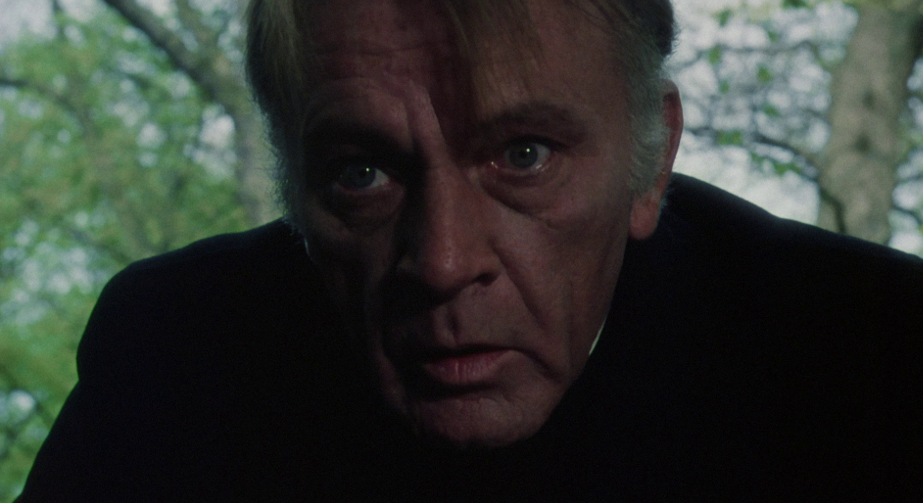
Visually, ‘Absolution’ is a more restrained affair. Page and cinematographer John Coquillon create an appropriately austere atmosphere, with the cold and enclosed environments of the boarding school reflecting the film's themes of repression and moral uncertainty. While the cinematography features a few interesting flourishes, particularly in the way it captures the isolation of the school setting, it is generally more competent than genuinely striking.
Stanley Myers’ score works effectively in building tension and unease, complementing the film's psychological elements without overpowering them. However, John Victor Smith’s editing could have been tighter in places, with some scenes lingering longer than necessary, contributing to the overall pacing issues.

Richard Burton delivers a deeply nuanced performance as Father Godden, capturing the character's gravitas, conviction and inner turmoil brilliantly. You get the sense that he believed in the project, making more of an effort than he sometimes did when he felt the material was beneath him- which, in fairness, it often was. Burton brings a great deal of sympathy to the role, ensuring that Godden is never simply an overbearing figure of authority, but rather a deeply flawed individual struggling with doubt, guilt and his own need for certainty.
Billy Connolly also makes an impression in a small but pivotal role as Blakey, a transient whose brief appearance adds another layer of mystery to the story. The younger cast members are somewhat more uneven. Dominic Guard brings a quiet ambiguity to Benjie, making the character difficult to fully understand or trust, compounding the tension of proceedings. David Bradley, meanwhile, is less subtle as fellow student Arthur, veering into more exaggerated territory.

Overall, ‘Absolution’ is an imperfect but compelling psychological thriller, bolstered by one of Richard Burton's finest later-career performances. While the film occasionally struggles with pacing and concludes on a more melodramatic note than it can support, its examination of faith, guilt and obsession remains intriguing. The days of Burton being a cinematic God may have passed for some, but his performance in ‘Absolution’ is quite close to divine.


